Renovation Debris Disposal in Singapore: Rules and Costs
What counts as renovation debris, the NEA rules on disposal, how debris leaves a hacking job, protecting lifts and common areas, who is responsible, and what it costs.
Jun Wei
8 min read
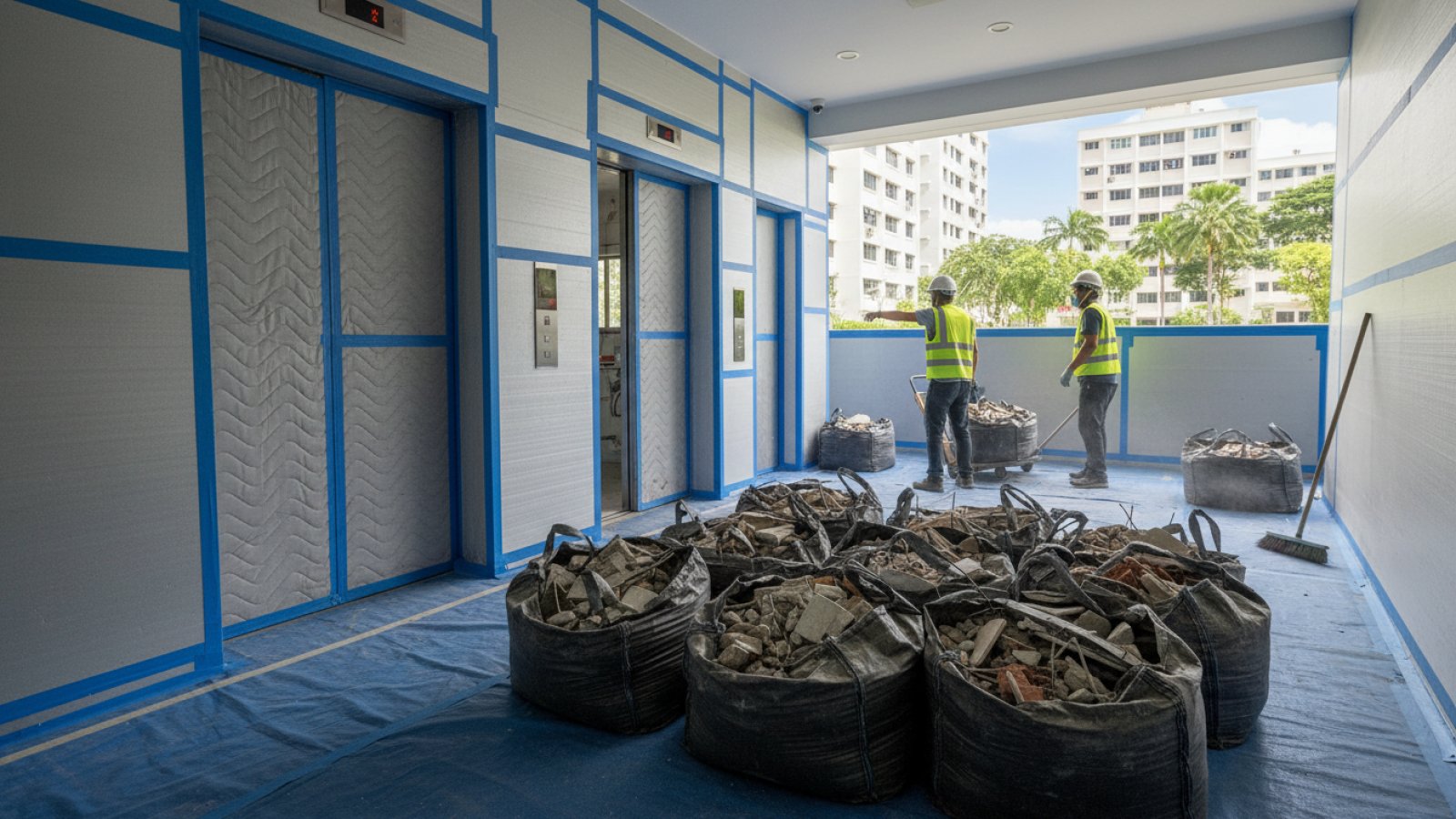
Renovation debris disposal in Singapore is regulated: hacking waste has to go to a licensed disposal facility, and illegal dumping is prosecuted. For homeowners, the practical questions are who handles it, how it gets out of the building, and what it costs. Published market ranges put haulage and debris clearance at about S$500 to S$1,500 per job, and a single small-lorry trip with labour and compliant disposal at about S$300 to S$500.
This guide covers what counts as renovation debris, the rules that apply, how disposal works on a hacking job, and how to make sure yours is handled properly.
What counts as renovation debris
Renovation debris is everything removed during the works that is not being kept. On a hacking job, most of it is heavy, inert material.
- Inert debris: broken tiles, screed, mortar, brick, blockwork and concrete pieces
- Timber and board: carpentry, doors, skirting, ceiling boards and plywood
- Metal: frames, studs, fixings, sinks and fittings
- Glass: shower screens, mirrors and partition panels
- Sanitary ware: WCs, basins and bathtubs
- General waste: packaging, protection materials and old fittings
Volume is easy to underestimate. A single built-in wardrobe fills far more space than it seems to, and tile and screed are heavy for their size. A full flat strip-out often needs several lorry trips.
NEA rules on renovation waste
Construction and renovation waste must be disposed of at licensed facilities, and the National Environment Agency (NEA) enforces against illegal dumping.
Under the Environmental Public Health Act, illegal dumping can lead to a fine of up to S$50,000, imprisonment of up to 12 months, or both, for a first offence, with heavier penalties for repeat offenders. NEA regularly publishes cases, including fines for illegally dumping renovation waste. In one, a company director was fined a total of S$18,000 over the illegal disposal of waste from renovation works.
For homeowners, the point is simple: use a contractor who disposes of debris properly, and ask how and where it goes. A low price that does not include licensed disposal is a warning sign.
How disposal works on a hacking job
On a well-run job, debris is bagged as it is produced, moved out regularly, and taken straight to a licensed facility.
- Bagging at source. Debris goes into heavy-duty bags as the hacking proceeds, rather than being piled on the floor.
- Sorting. Inert material, timber, metal and general waste are separated where practical, which some facilities require.
- Moving out. Bags are carried through the protected route to the lift and down to the loading point at permitted times.
- Loading. The lorry is loaded promptly, so bags are not left in common areas.
- Disposal. The load goes to a licensed disposal facility.
Debris should never be left in corridors, staircases or void decks, even overnight. Apart from the nuisance to neighbours, it is a fire safety and obstruction issue.
Protecting lifts and common areas
Lifts and corridors take a beating from debris bags. Protection goes in before the first load and stays until the last.
In HDB blocks, the Town Council manages common property, and contractors are expected to protect lifts and keep common areas clean. In condominiums, the MCST usually sets out specific requirements, such as lift protection panels, floor protection in lobbies, set hours for removing debris, and a refundable deposit returned after inspection. Some condos restrict debris removal to the service lift and specific time slots.
Damage to lifts or common areas can be charged to the owner, so it is worth confirming that your contractor's quote includes proper protection.
Who is responsible for disposal
Your contractor carries out the disposal, but as the owner commissioning the work you have an interest in making sure it is done properly.
Ask your contractor three questions before work starts:
- Is disposal included in the price, and how many lorry trips does that cover?
- Where does the debris go?
- How will lifts and common areas be protected, and when will debris be removed?
A clear answer to all three is a good sign. Vague answers, or a price far below others that leaves disposal out, are reasons to look elsewhere. Our guide to choosing a hacking contractor covers other checks.
Debris in HDB blocks: practical rules
HDB blocks are shared, busy buildings, and debris handling is one of the things neighbours notice most.
- Bag everything. Loose debris should never be carried through the corridor or lift.
- Protect the lift. Lift walls and floor are covered before the first bag goes in.
- Move debris promptly. Bags go from the flat to the lorry, not to the corridor or the void deck to wait.
- Keep the corridor clean. Sweep and clear dust at the end of each day.
- Use the permitted hours. Noisy works are limited to 9am to 5pm on weekdays, and debris removal is best planned within that window too.
These rules are simple, and following them avoids complaints to the Town Council and friction with neighbours who will be living next to you long after the renovation ends.
Debris in condominiums and commercial buildings
Condominiums and commercial buildings usually set their own, stricter rules for debris.
Condo MCSTs commonly restrict debris removal to the service lift at set times, require lift and lobby protection, and hold a deposit until the common areas are inspected. Malls and office towers often allow removal only through the loading bay, sometimes only after hours, with slots booked in advance. A contractor working in these buildings needs to plan the job around those slots, which can mean more, smaller trips.
Sorting and recycling
Sorting debris on site is good practice and is required by some disposal facilities.
Inert material such as tile, concrete and screed, timber and board, metal, and general waste are kept separate where practical. Metal is often recycled. Clean timber and some inert material can also be recovered at suitable facilities. Sorting takes a little more time on site but makes disposal straightforward and keeps material out of landfill where possible.
Disposal cost
Published market ranges put haulage and debris clearance at about S$500 to S$1,500 per job, and a single small-lorry trip with labour and compliant disposal at about S$300 to S$500.
| Item | Typical market range |
|---|---|
| Haulage and debris clearance, per job | S$500 to S$1,500 |
| Single small-lorry trip, labour and compliant disposal | S$300 to S$500 |
What moves the cost:
- Volume and weight. More debris means more trips. Tile and screed are heavy; carpentry is bulky.
- Access. High floors, long walks to the loading point and restricted lift slots add labour.
- Sorting. Mixed loads may cost more to dispose of than sorted ones.
- Timing. Removal restricted to specific hours can mean more, smaller trips.
Many hacking quotes include disposal within the price. Where it is separate, it should be listed clearly. See our hacking price list for how disposal fits into other job types.
How much debris different jobs produce
Debris volume is the biggest driver of disposal cost, and it varies widely by job.
| Job | Debris | Typical disposal need |
|---|---|---|
| Single partition wall | Heavy inert debris: brick, plaster, tiles | Often within one small-lorry trip |
| Bathroom strip | Tiles, screed, sanitary ware | One trip, sometimes shared with other works |
| Kitchen strip-out | Carpentry, countertop, tiles | One to two trips |
| Whole-flat floor hacking | Heavy tile and screed debris | Several trips, depending on area |
| Full flat strip-out | Everything above | Several trips over the job |
| Office reinstatement | Partitions, ceiling, carpet, joinery | Multiple trips, often after hours |
These are general guides only, since the actual number of trips depends on the vehicle, the materials and the building's rules. The point is that a full strip-out is not one trip, and a quote that allows for only one should be questioned.
Signs of a careless disposal arrangement
A few signs suggest that debris may not be handled properly:
- No mention of disposal in the quote at all
- A price far below other quotes for the same scope
- Vague answers about where the debris will go
- Debris left in common areas overnight
- Unmarked vehicles or an unusually small vehicle for a large job
If you see any of these, ask directly. A contractor who disposes properly will be happy to explain how.
Reducing what needs disposal
The cheapest debris is the debris you do not create.
- Keep what is sound. A floor in good condition may be overlaid rather than hacked; see floor hacking cost.
- Sell or donate. Good-quality furniture, appliances and fittings can often be sold or given away before the strip-out.
- Dismantle rather than smash. Carpentry taken apart in sections packs more tightly and is easier to sort.
- Combine the works. Doing all the hacking in one go means fewer, fuller trips.
Our dismantling and disposal service handles removal and licensed disposal for homes and commercial units. Request a quote and tell us what needs to go.
Sources
- NEA advisory: illegal disposal of waste from renovation works, and NEA's published penalties under the Environmental Public Health Act.
- Published Singapore hacking contractor guides, 2026: haulage, debris clearance and lorry trip costs; MCST conditions on removal.


