Floor Hacking Cost in Singapore (2026): Hack or Overlay?
What floor tile hacking and screeding cost per square foot, when an overlay is the better choice, when hacking is unavoidable, and a worked example for a 700 sq ft flat.
Jun Wei
7 min read
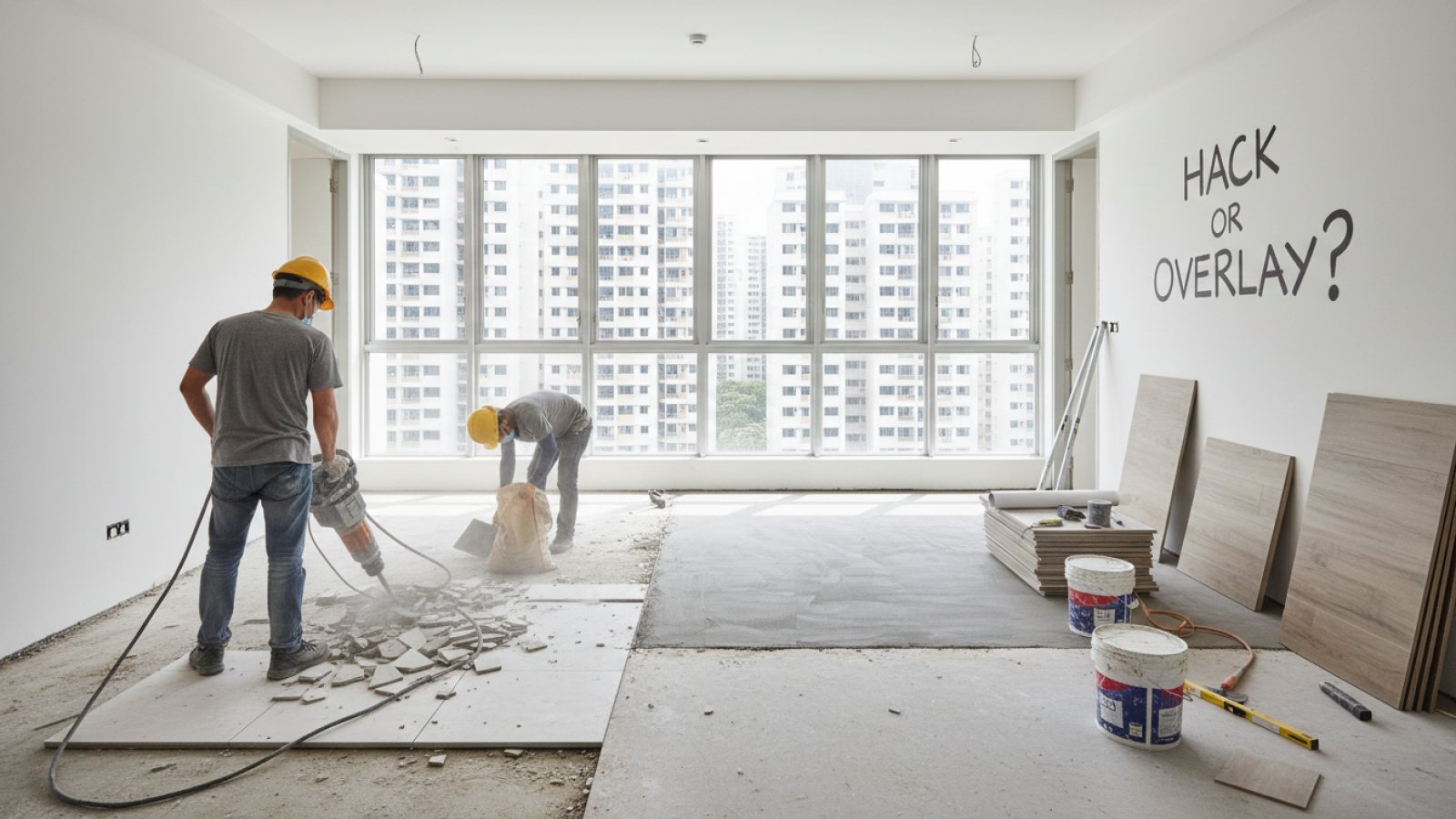
Floor hacking cost in Singapore runs about S$3 to S$8 per square foot to remove existing tiles, plus about S$1 to S$3 per square foot to screed and level the floor afterwards. Combined, that is roughly S$4 to S$11 psf, or about S$2,800 to S$7,700 for a 700 sq ft flat. Overlaying new tiles or vinyl on the old floor avoids the hacking entirely, at a similar price per square foot for the new finish, but it does not suit every floor.
These are published market ranges from SmartCalculator.sg's 2026 flooring guide, not our prices. This article explains each cost, when an overlay works, and when hacking is the only sensible option.
Floor hacking cost per square foot
Hacking existing floor tiles typically costs S$3 to S$8 psf in Singapore. The spread comes from the tile, the bed beneath it, and the job around it.
| Item | Typical market range |
|---|---|
| Hacking existing floor tiles | S$3 to S$8 psf |
| Screeding and re-levelling after hacking | S$1 to S$3 psf |
| Hack and screed combined | S$4 to S$11 psf |
| Overlay tiles, no hacking | S$3 to S$9 psf |
| Vinyl or SPC overlay | S$4 to S$10 psf |
What pushes the hacking rate up:
- Thick or hard finishes. Homogeneous tiles on a thick mortar bed, or marble, take longer to break out than thin ceramic.
- Previous overlays. Two layers of tiles mean twice the hacking and twice the debris.
- Small or awkward areas. Fixed costs for protection, setup and disposal do not shrink with the area, so small jobs cost more per square foot.
- Occupied homes. Extra dust screening and protection where people are still living in the flat.
- Disposal. Tile and screed debris is heavy, and may need several lorry trips.
Screeding after hacking
Screeding at about S$1 to S$3 psf rebuilds a flat, level base after the old tiles and bed are removed. It is not optional if new tiles are going down.
Hacking rarely leaves a perfectly even surface. The screed brings the floor back to a consistent level, sets the falls to drains in wet areas, and gives the new finish something sound to bond to. It needs time to cure before tiling, which is worth building into the programme. In wet areas the waterproofing sits within this build-up, which is covered below.
Overlay options and when they work
An overlay lays the new floor directly over the existing one, with no hacking. It works well when the existing floor is sound and level, and the extra height is acceptable.
Tile overlay (S$3 to S$9 psf) bonds new tiles on top of the old ones with a suitable adhesive. It is quieter, faster and cleaner than hacking, and produces almost no debris.
Vinyl or SPC overlay (S$4 to S$10 psf) is thinner and lighter, and is laid over the existing floor as planks or tiles. It is popular for bedrooms and living areas, and adds very little height.
An overlay is a good choice when:
- The existing tiles are firmly bonded, with no hollow spots or cracks
- The floor is level enough for the new finish
- Doors, thresholds and built-ins can tolerate the extra height
- The area is dry, such as bedrooms and living rooms
When you must hack the floor
Hacking is the right choice when the existing floor is unsound, when height is a problem, or when waterproofing is involved.
Hollow or loose tiles
Tap across the floor with a coin or a small tool. A hollow sound means the tile has lost its bond with the bed. Overlaying on top of hollow tiles transfers the problem to the new floor, and the new tiles can crack or lift. A few hollow tiles can sometimes be replaced locally; widespread hollowness means hacking.
Height and thresholds
A tile overlay adds height. That can leave a step at the main door, make doors scrape, or create level differences between rooms. In kitchens, it can change the fit under cabinets and appliances. Where the height cannot be absorbed, hacking is the answer.
Wet areas and waterproofing
Bathrooms and other wet areas have a waterproofing membrane beneath the screed. If the floor is hacked down to the membrane, or beyond, the waterproofing has to be redone and tested before new tiles go down. Our article on waterproofing and floor hacking damage explains the risks, and the toilet hacking cost guide covers bathrooms specifically.
Approval
Removing floor finishes in an HDB flat is hacking work and needs a renovation permit before it starts. HDB also restricts replacing bathroom floor finishes in the first three years after a block is completed. Confirm the current rules with HDB before you fix dates.
Choosing a floor finish after hacking
Once the floor is hacked and screeded, you can lay almost any finish. The choice affects cost, durability and how the floor handles Singapore's humidity.
- Porcelain or homogeneous tiles are hard-wearing, water-resistant and suit every room, including wet areas. They need a level screed and good workmanship at the joints.
- Vinyl or SPC is warmer underfoot and quieter, and is quick to install. It suits bedrooms and living areas but not wet areas.
- Timber or engineered wood looks good but needs a dry, stable base and care in humid conditions.
- Marble is heavy and expensive, and needs specialist laying and maintenance.
If you are hacking anyway, the screed can be set to suit the new finish, which avoids the height and threshold compromises of an overlay.
Signs your floor needs hacking now
Some floors make the decision for you. Hacking is usually the right call if you see:
- Tiles that move, crack or lift, or grout that keeps breaking up
- Widespread hollow sounds when you tap across the floor
- Tiles "popping", where tiles suddenly arch up from the floor, often in older flats or after temperature changes
- Water stains on the ceiling of the flat below a bathroom or kitchen
- Uneven levels that make doors scrape or furniture rock
Any of these means the bond between tile and screed has failed. An overlay on top would inherit the problem.
Worked example: a 700 sq ft flat
For a 700 sq ft flat, hacking and screeding the whole floor costs roughly S$2,800 to S$7,700 at published rates, before the new finish.
| Option | Rate | 700 sq ft |
|---|---|---|
| Hack and screed | S$4 to S$11 psf | S$2,800 to S$7,700 |
| Tile overlay, no hacking | S$3 to S$9 psf | S$2,100 to S$6,300 |
| Vinyl or SPC overlay | S$4 to S$10 psf | S$2,800 to S$7,000 |
Two points stand out. First, the overlay figures are for the new finish, while the hack and screed figure is only the preparation, so a hacked floor still needs new tiles on top. Hacking is therefore the more expensive route overall. Second, a mixed approach is common: hacking wet areas and any hollow sections, and overlaying the rest. That often gives the best balance of cost and quality.
These figures are illustrations built from published ranges, not quotes. For other job types, see our hacking price list.
How long floor hacking takes
For a typical flat, the floor hacking itself takes two to four working days, and screeding another one to two days plus curing time before tiling.
The main factors are the area, the tile and bed thickness, whether there are layers of old tiles, and how quickly debris can leave the building. In HDB flats, noisy works are limited to 9am to 5pm on weekdays, so a job that would take three long days elsewhere may stretch across a week. An overlay, by contrast, is often laid in a day or two with little disruption, which is part of its appeal when the floor is sound.
Hacking without the mess
Floor hacking is one of the dustiest renovation jobs, so how it is done matters as much as the price.
Retained areas and built-ins are protected and sealed off, debris is bagged as it is produced rather than left in piles, and the route out of the flat is protected. Noisy works in HDB flats are only allowed from 9am to 5pm on weekdays. Our floor and tile hacking service page explains our process.
Request a quote for floor hacking with photos of the floor and its approximate area.
Sources
Figures are published market ranges, reviewed October 2026, and are indicative only.
- SmartCalculator.sg, Flooring Cost Singapore (2026): tile hacking, screeding, overlay and vinyl rates.


